

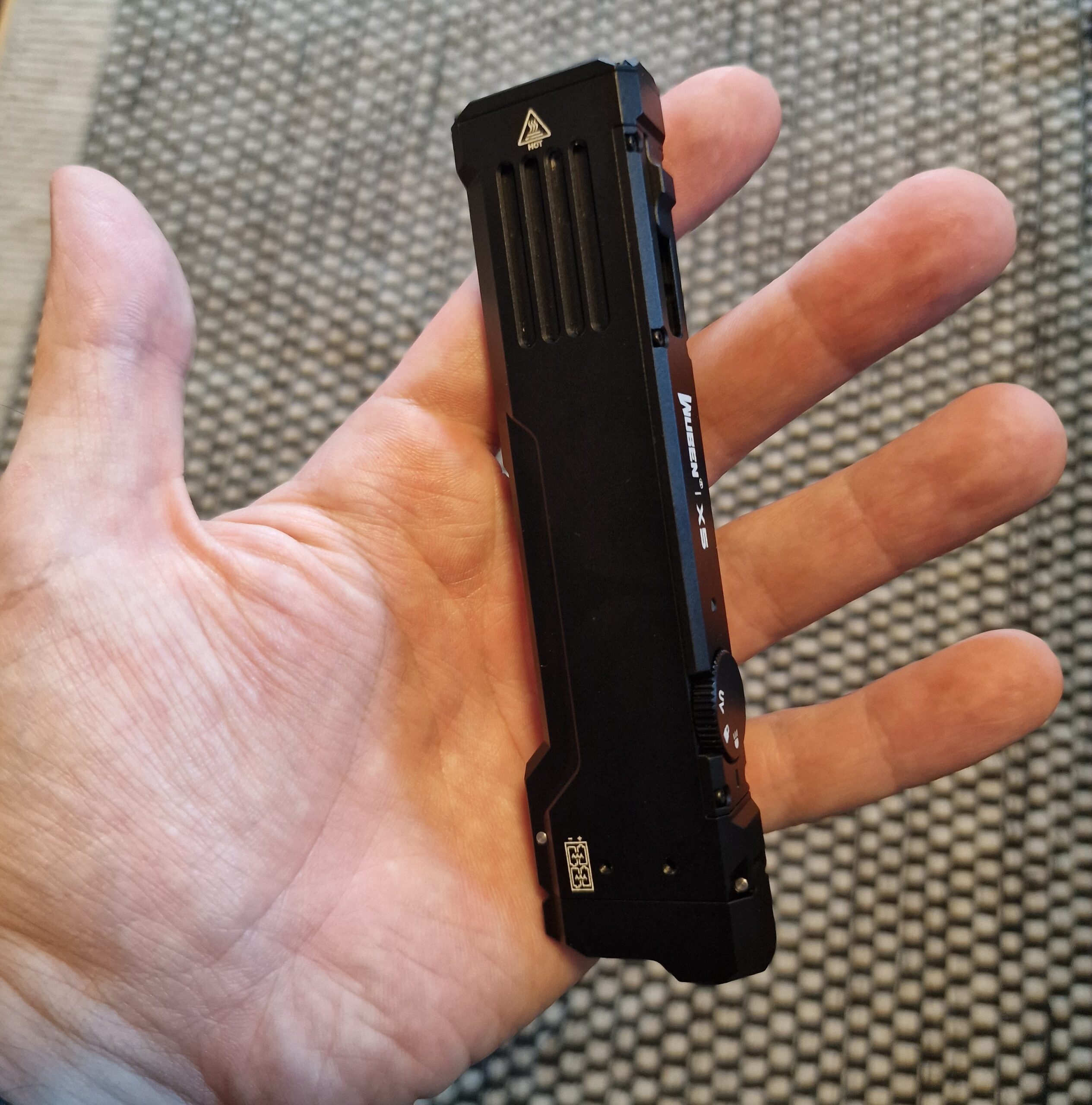
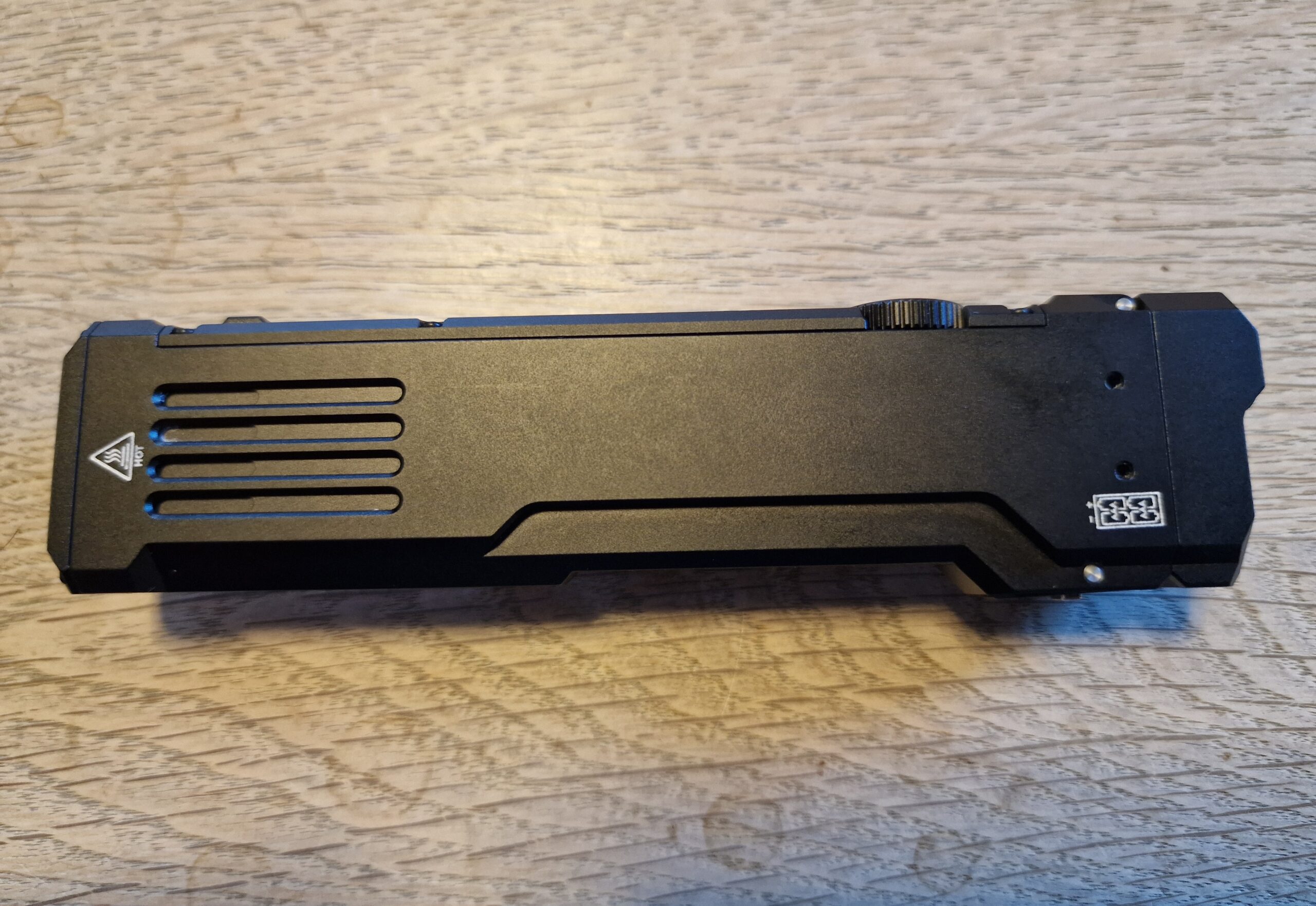
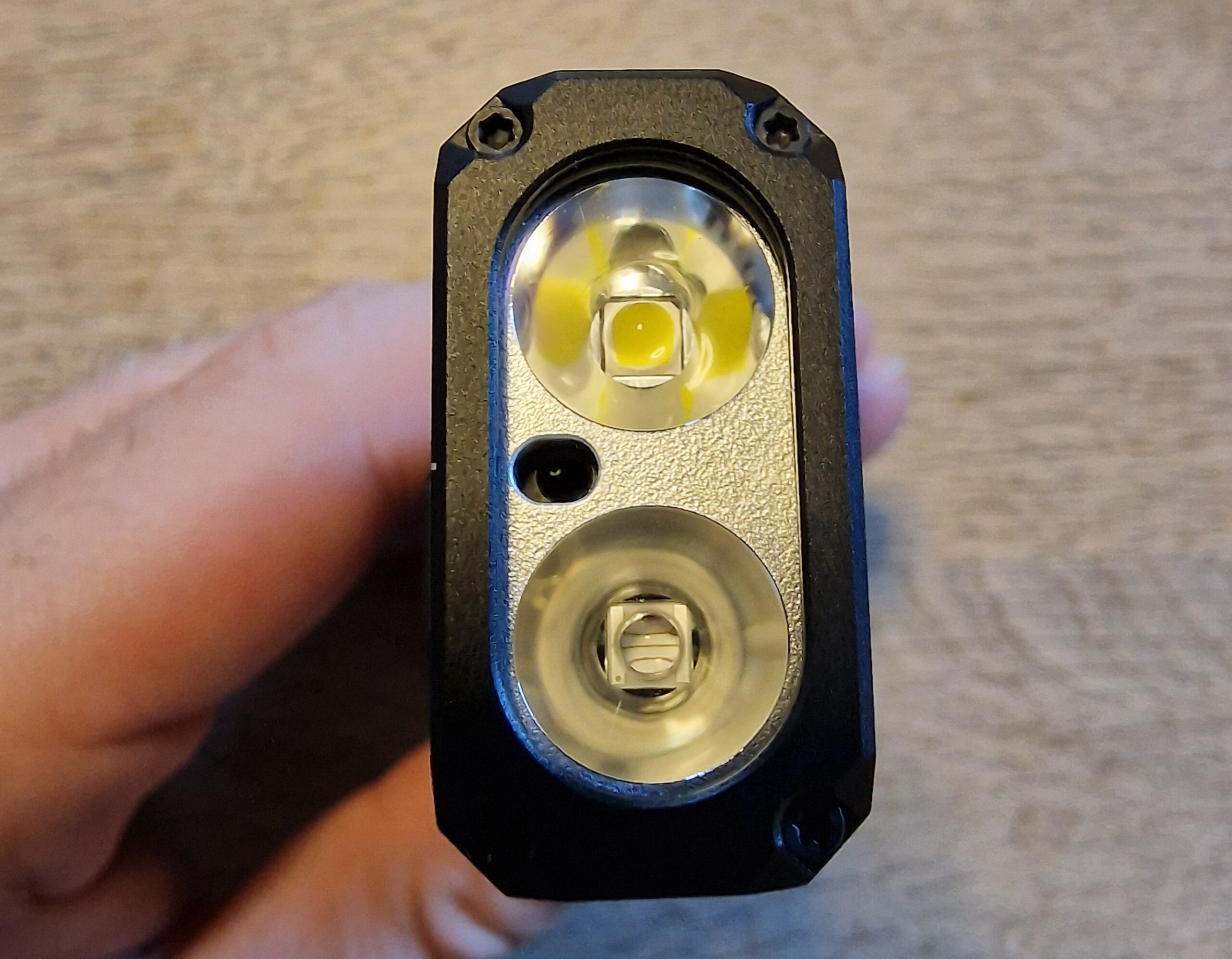
A fun, capable EDC flat light with dual-fuel compatibility and a premium build, let down mainly by a distractingly green tint on its lower modes.
Disclaimer: The Wuben X5 was sent to me by Wuben free of charge for testing and review. However, all thoughts, measurements, and opinions expressed in this post are completely my own honest assessment.
The X5 is my first non-high-powered light from Wuben. I own their A1, and since I was blown away by its build quality and performance, I had high hopes for the X5, even though it is a completely different and much cheaper light.
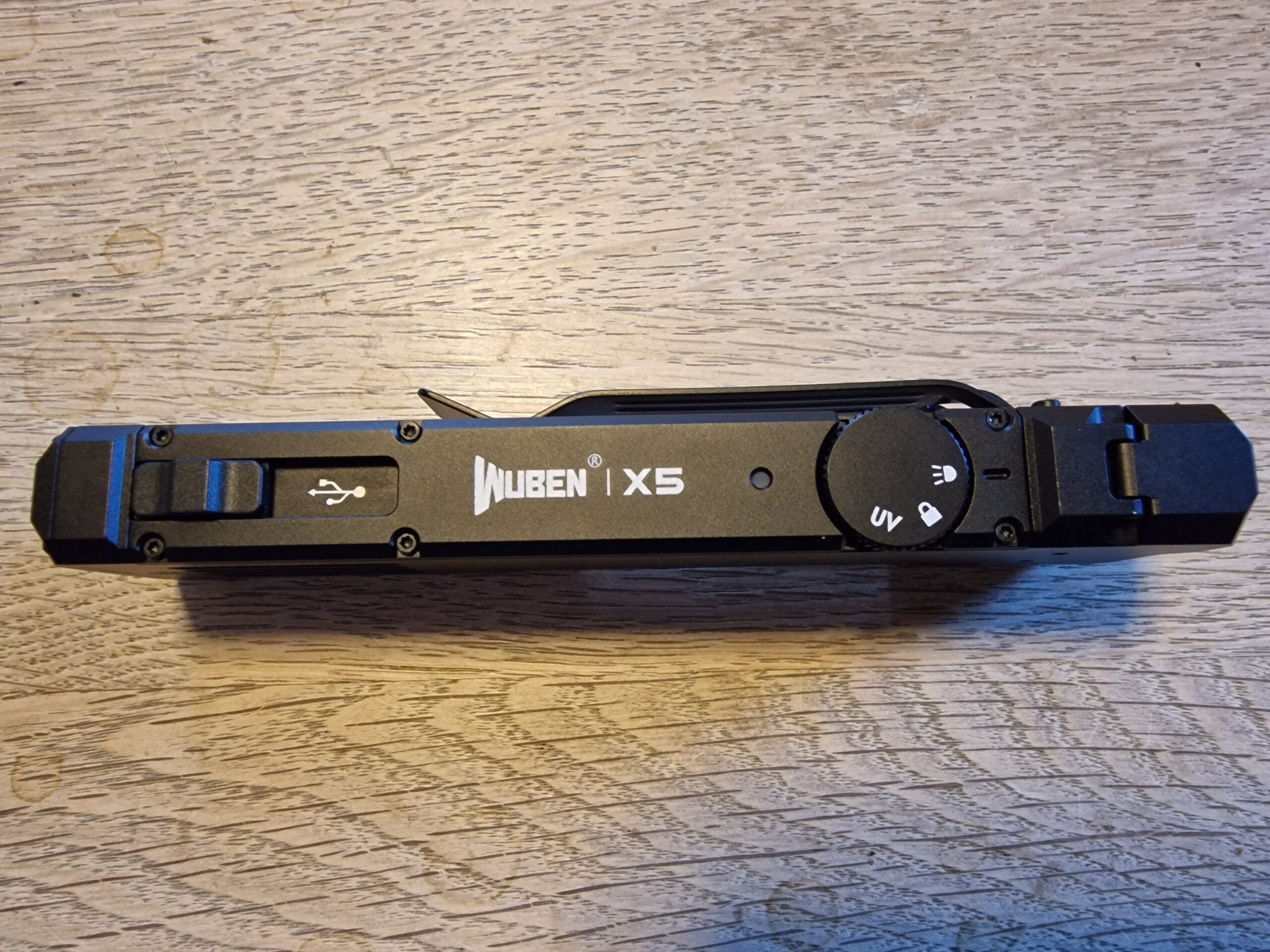
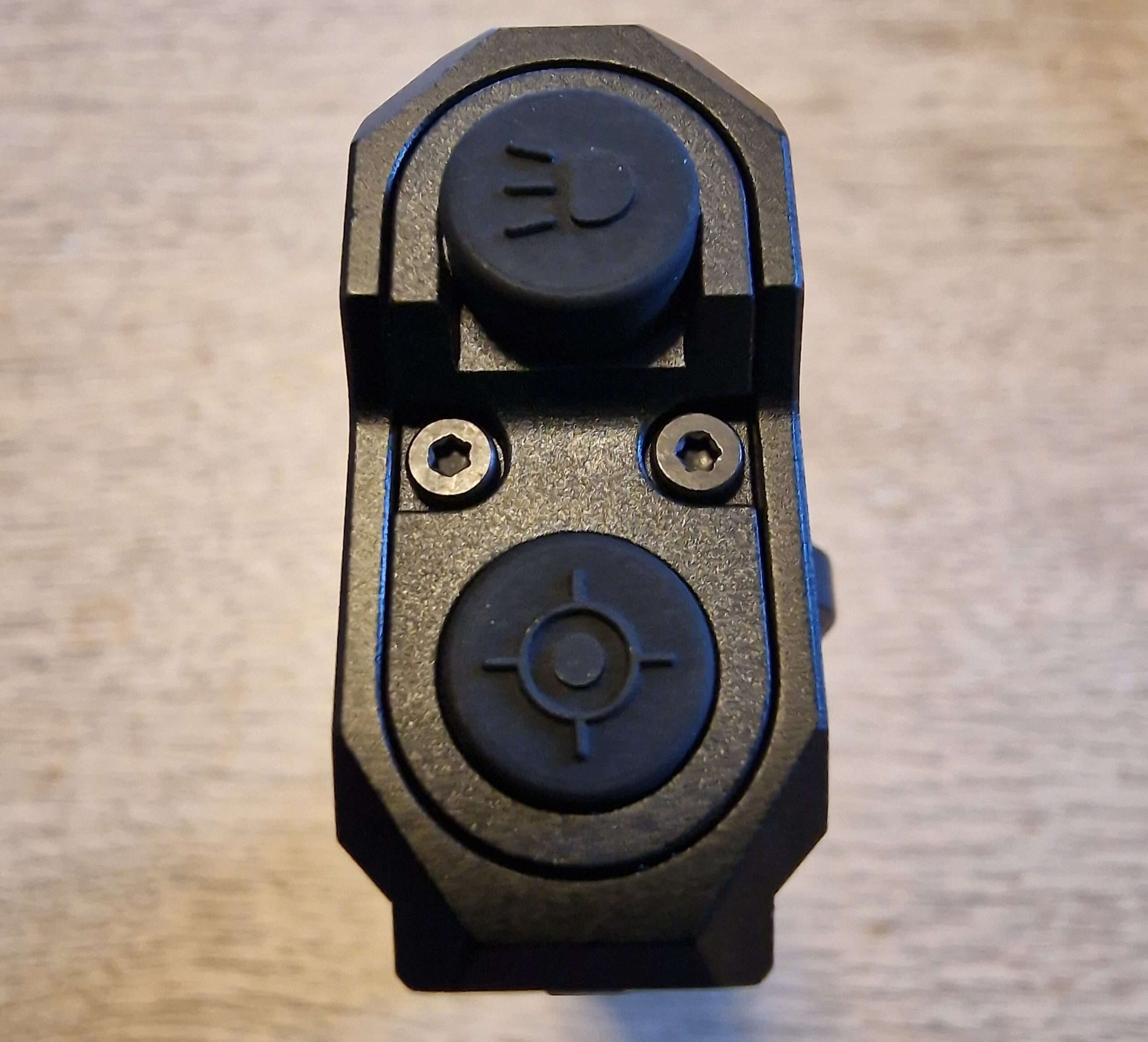
The build quality is actually the thing I am most impressed with, it is really well-built and feels good in the hand. The ergonomics are a bit weird, though, specifically the side rotary dial and tail-switch combo. It feels a bit awkward to use because you have to shift the light quite a bit to get from the tail-switch to the side dial. I honestly would have liked all the controls to be on the back. That being said, the dial itself feels really nice and clicky, and the tail-switch is even better, with a half-click for momentary and a full press for constant-on. There is also a dedicated laser button on the tail that can be used simultaneously with the main light and the UV light.
The dual-fuel compatibility is something that was really interesting to me, as I haven't heard of any other flat lights that have it. I am fine with just using the proprietary battery most of the time, but it is really nice to be able to use 4x AAA batteries in an emergency or if you don't have access to a charger or powerbank.
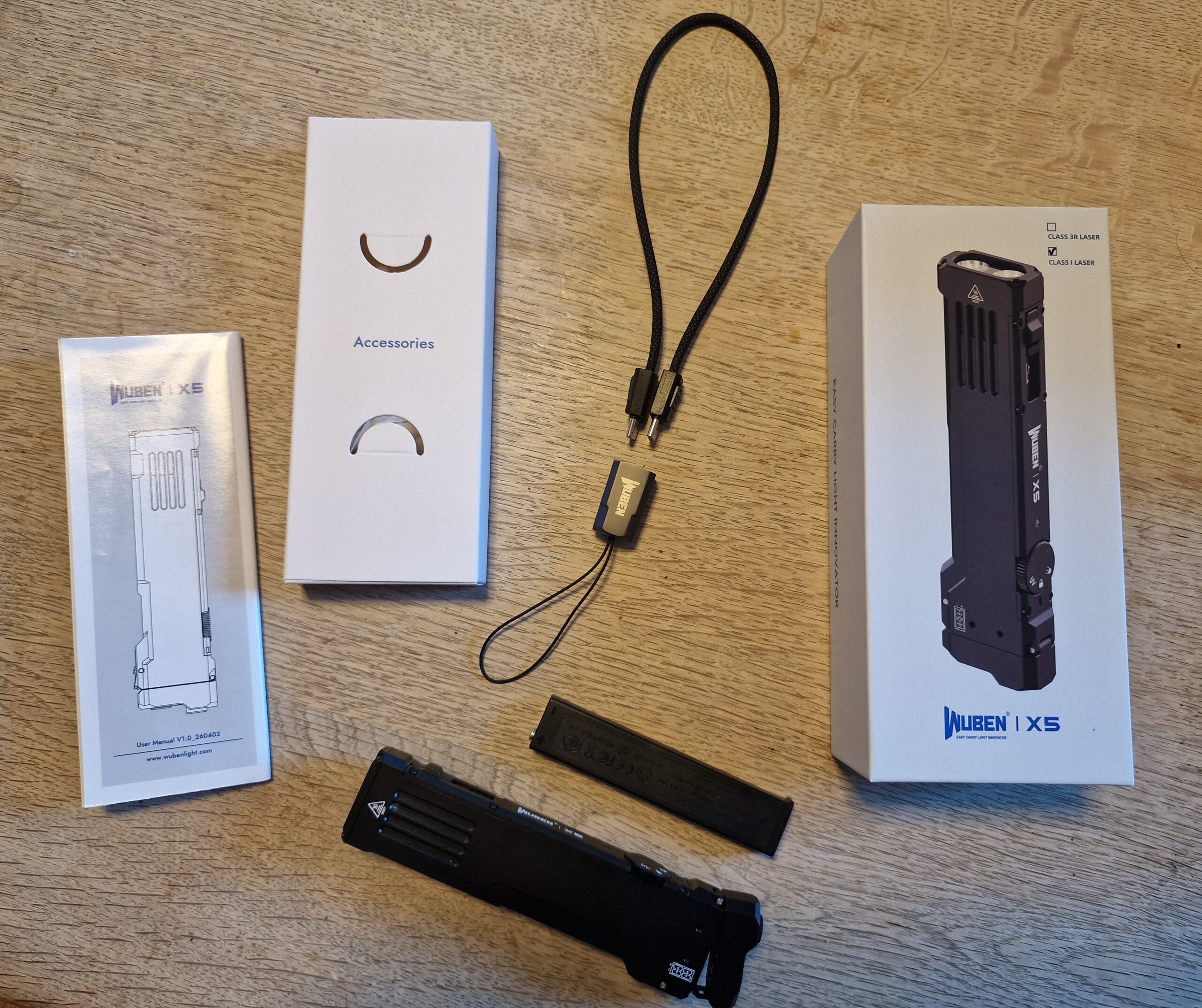
📦 What's in the Box
- X5 (Class 1 / Class 3R laser version) × 1
- Type-C zinc alloy charging lanyard × 1
- L-shaped hex wrench (H1.5) × 1
- User manual × 1
📏 Physical Specifications
🛠️ Test Equipment
📷 Camera Settings
📸 Beamshots
⚡ Battery & USB-C Charging Analysis
🕹️ User Interface
Side rotary dial sets the active mode: Lock, UV, or White Light. Illumination button: half-press for momentary light, full click for constant-on; tap to cycle brightness levels, double-tap for strobe. Laser button: dedicated button that triggers the laser, usable simultaneously with the main or UV light.
🔧 Measurement Setup
📊 Output, Tint, Throw & Beam Profile
| Mode | Output (lm) | CCT | DUV | CRI (Ra) | Intensity (cd) | ANSI Throw | Usable Throw | Ratio |
|---|---|---|---|---|---|---|---|---|
| Eco | 3 | 4692K | 0.0107 | 70 | — | — | — | — |
| Low | 57 | 4721K | 0.0097 | 70 | 175 | 26m | 13m | 3.07 |
| Med | 172 | 4660K | 0.0093 | 69 | 575 | 48m | 24m | 3.34 |
| High | 403 | 4673K | 0.0086 | 69 | 1325 | 73m | 36m | 3.29 |
| Turbo | 1340 | 4785K | 0.0045 | 69 | 4550 | 135m | 67m | 3.4 |
📈 Runtime & Thermal Analysis
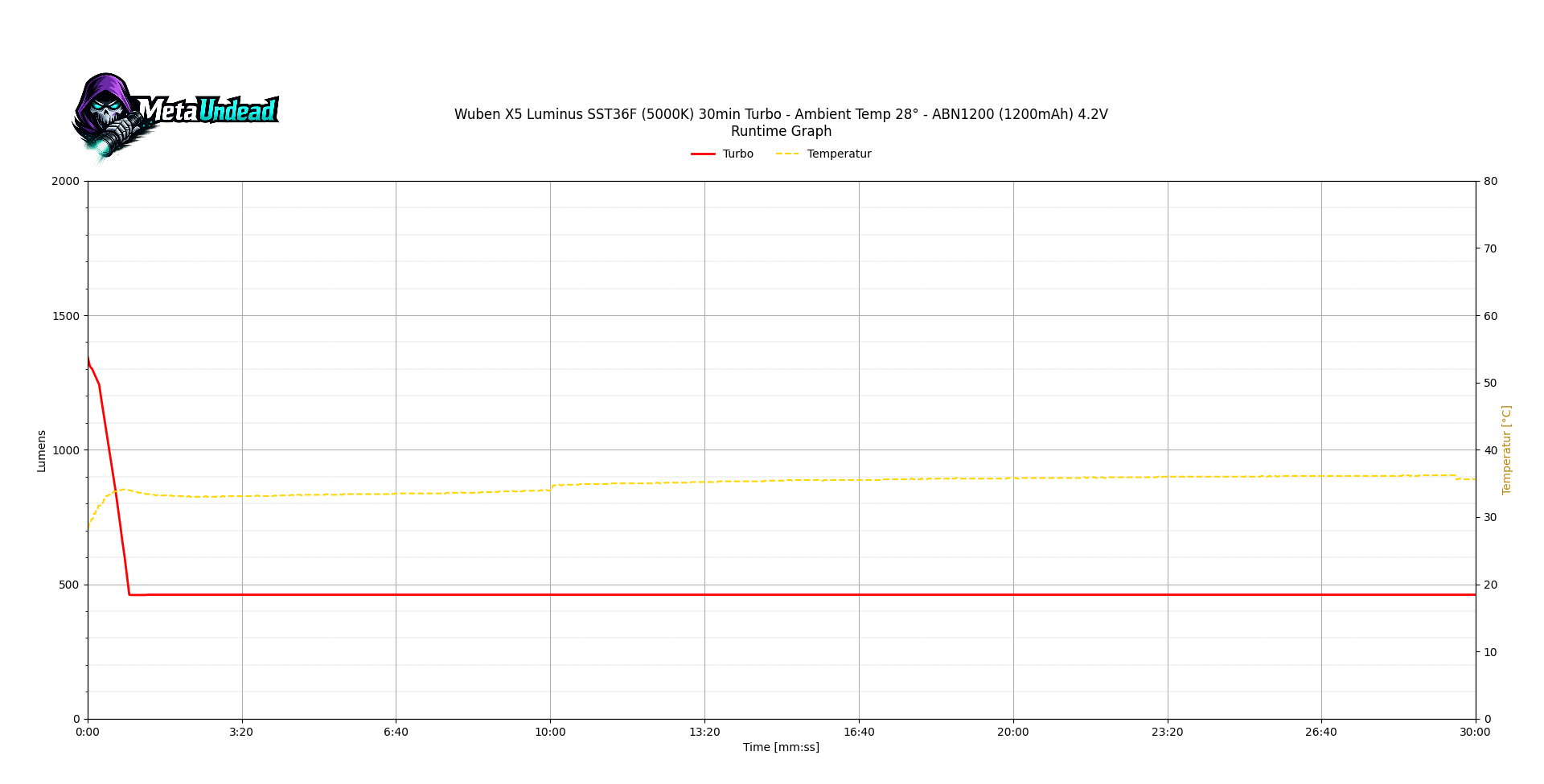
Turbo & Step-down: Proprietary Battery: starts at 1340 lumens but drops steeply within the first 60 seconds, settling just below 500 lumens by the one-minute mark. Alkaline AAA: Turbo output is significantly lower, peaking at approximately 920 lumens before dropping rapidly to match the sustained output level of the proprietary battery.
Sustained Output: Once stepped down, the driver maintains a perfectly flat and steady output of roughly 470 lumens for the remainder of the 30-minute test duration, regardless of the power source.
Thermal Performance: The thermal regulation is incredibly conservative. It peaks at around 35°C during the initial turbo phase, then slowly creeps up to roughly 38°C by the end of the 30 minutes. The host stays practically cool to the touch throughout the entire run.